
On the question of prologues
Why I decided to add one to my novel

Where do you stand on the question of prologues?
I dithered on them for quite a while. I have read that readers skip them, that they’re old-fashioned, that agents hate them, that just no.
Even the sublime Elmore Leonard, one a my favourite crime writers, had an issue with them. In his famous 10 rules for writing, the second rule is: avoid prologues. ‘They can be annoying,’ he wrote. ‘A prologue in a novel is back story, and you can drop it in anywhere you want.’
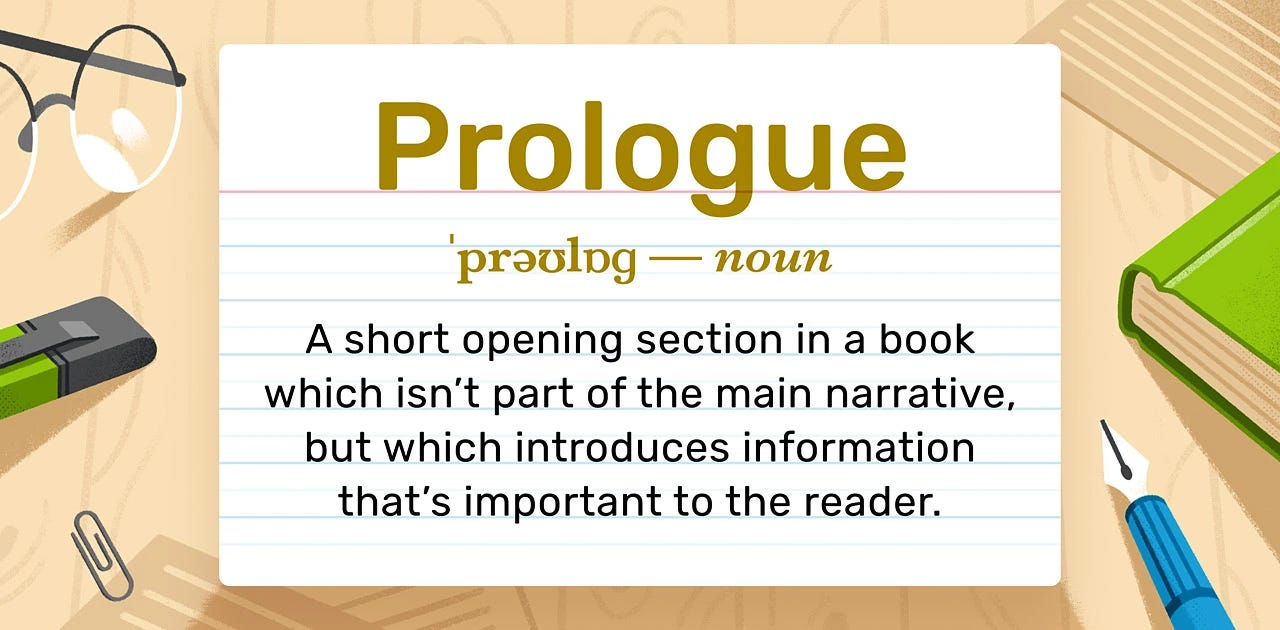
But then, I’ve also noticed that mysteries, suspense, and crime thrillers in both book and TV serial form often use them. I watch a lot of TV crime thrillers, and I’ve observed that short opening scenes (or prologues) can be very effective in hooking you into the story. I’ve also noted that , as you watch the story progressing, you forget about that scene until later, when it becomes clear how it fits with the story. I find this technique intriguing.
Adding a prologue
I didn’t have a prologue in my first draft. While working on my second draft, I read a number of crime thrillers. I noticed that writers such as Val McDermid and Louise Penny frequently uses atmospheric, tense prologues to set up their thriller narratives. In fact, many crime writers use a prologue to create a sense of foreboding, drawing the reader into their world before the main story unfolds.
I got to wondering if it would work on my novel and tried it, writing about 250 words about the disappearance of the woman who the book is really about. I liked it, for the reasons I’ve set out below.
Five reasons why I added a prologue
Here are five reasons why I decided to add a short prologue to the current draft of my crime fiction novel.
To Grab the Reader’s Attention
My novel proper starts with my protagonist waking up one morning and receiving a message from a possible relative. This, we find out over the course of the first chapter, may be the clue she needs to find out who her mother was, and who she really is. It’s an intriguing start, I feel, but it doesn’t immediately show you the fireworks that will soon be set off.
I want to pull the reader in first with a hook, and a prologue is a great way to do that. The prologue will act as the hook.
To Set the Tone
As befits a crime thriller, there are very dramatic events in the novel. We read about murder, violence, and secrets that have been hidden for many years. I need to ground the reader in the genre, to show them that things are going to heat up considerably. That’s why they’re reading this book, after all. Enter the prologue.
To Create an Emotional Attachment to a Character
The protaganist’s mother is already dead, so, though we hear a lot about her, we don’t actually see her in the novel. I want to show her right off the bat, to help readers to forge a strong emotional attachment to her. I want them to feel her.
To Ground Readers in Time and Place
My story is set in the present-day, but it’s all about events that happened in the past. I want to show my readers that time and that place, to have a sense of it, to feel how it might have felt. At a certain point in the book, they will remember this scene.
5. To Pose a Question or Two
At the end of my prologue, the reader is left with questions about what happened to this woman. These are questions that will project them into the book, and, hopefully, sustain their interest.
So….
Where I’ve landed on prologues is that they can be effective, as long as you use them for the right reasons. I think the ‘rules’ about writing prologues, along with many other writing rules tbh, can be taken with a pinch of the proverbial salt. And yes, that even means those of my hero Elmore Leonard. Sorry Elmore.
So far (and I’m not finished drafting yet), I think a prologue works in the case of my specific book. Time will tell if it stays there, but for now, I feel it earns its place.
What about you?
So where do you stand on the subject of prologues? Have you noticed any particularly effective prologues in books you’ve read?
Prologues are great if they add something to the story that wouldn’t be anywhere else.
Your example of the woman before she is murdered is a good one.
It happens a lot in bad fantasy fiction - the prologue stops us from getting to the action. Having to read 3000 words explaining the world and the magic system, when you could just dive straight into the dragon eating the knight.
I also added a prologue to my first draft. I’ve been uncertain about whether to keep it. I have now rewritten it to improve clarity on the advice of some feedback and now feel it deserves its place, hinting at the drama which unfolds later,